YouTube ads have always been treated as a brand awareness channel for B2B SaaS. Top of funnel, cheap views, nice reach numbers to show in a quarterly report.
We fell for that exact same narrative until last year.
That’s when we started testing Demand Gen campaigns on YouTube for a manufacturing ERP client and saw something we genuinely didn’t expect: actual pipeline. Not view-through conversions (which are mostly noise), not assisted clicks. Real demo requests from people who had never heard of the product before seeing the ad.
Here is the unfiltered data, what broke, and how we set it up.
Why YouTube Is Worth Reconsidering for B2B SaaS
We found out the hard way that treating YouTube purely as a top-of-funnel play is costing SaaS teams massive pipeline. The platform changed enough over the last couple of years, between Demand Gen campaign types, better algorithm signals and YouTube’s growing dominance in Google search results, that the conditions are now there to test it for pipeline generation.
Why YouTube Is Worth Reconsidering for B2B SaaS
We found out the hard way that treating YouTube purely as a top-of-funnel play is costing B2B SaaS teams missing pipeline.
Three things shifted that make it worth testing seriously now:
Content consumption changed. People are less likely to consume long form articles (hope this is not the case with this one) and more willing to digest information through video or podcast. This is not a new trend but it now affects how B2B audiences consume content too. If you want to learn how to migrate SAP your first reflex is to go to YouTube for the tutorial, not Google a blog post. And more content is being naturally created on YouTube as its visibility increases. YouTube now dominates most of the first results on Google and increasingly in LLMs too.
The platform improved significantly. Before, YouTube ads meant In-Stream views and not much else. Now YouTube inventory can also be used by Performance Max and Demand Gen campaigns, which adds more possibilities for advertisers to test different setups and take advantage of new targeting methods inside Google Ads.
Costs are still relatively cheap. This sounds like a simple argument but with search CPCs rising, cost per view and cost per click from YouTube ads are still relatively cheap compared to search. We are not comparing the same thing, but in an era where every B2B click on search costs more than it did a year ago, YouTube is an underpriced inventory worth testing.
What Doesn’t Work
Before getting to what works, it’s worth being honest about what doesn’t, because most B2B SaaS companies running YouTube ads today are using the wrong setup.
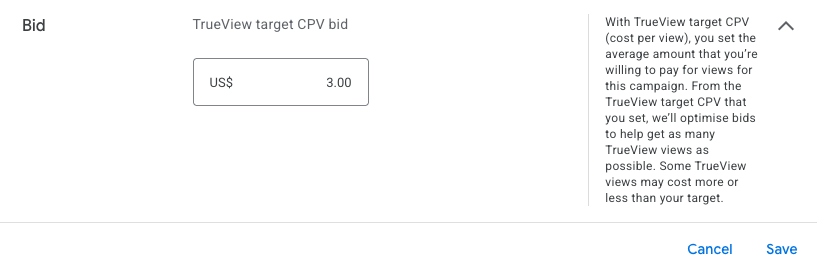
Only using traditional YouTube ads In-Stream campaign with Target CPV bidding optimizes for views and impressions. Google finds you the cheapest views it can. In B2B that means a lot of people who watched three seconds of your video before skipping, have no connection to your ICP, and cost almost nothing precisely because they have no buying intent.
We ran this for the manufacturing ERP client, targeting competitor YouTube channels and relevant placements. Altough we didn’t have received any conversions, the other numbers looked fine on the surface.
388,388 impressions. 47,145 views. Average CPV of $0.025. Total spend of $1,195.
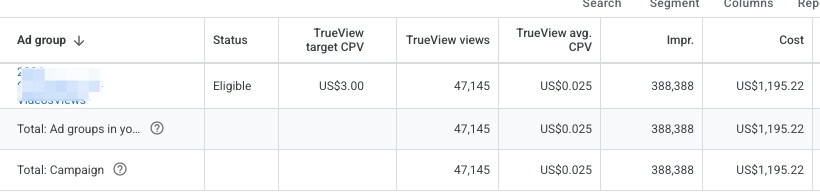
When we looked at GA4 the picture was very different. Average time on page after clicking through was under three seconds. Only 10% of visitors scrolled below the fold. The traffic was arriving and leaving immediately. Zero conversions over the entire campaign period.
The problem wasn’t the video or the landing page. It was the bidding strategy. Target CPV tells Google to find you the cheapest possible views, and the cheapest possible views in B2B are not your buyers. You are paying to reach people who happen to be watching adjacent content, not people who are actively evaluating your category.
One more thing worth mentioning from this test. The average CPV for YouTube video and channel placements was between $0.50 and $1. For keyword targeting it was less than $0.10.
That gap is telling you something. Keyword targeting on YouTube is a broad signal at best, reaching people who happen to be watching content adjacent to your category but have no specific intent. It looks cheap because it is cheap, and it is cheap because the audience quality reflects that.
Not worth the spend unless you want pure top of funnel reach and have accepted that conversions are not the goal.
The Setup That Actually Generated Pipeline
Demand Gen cold audience
The campaign type that changed things was Demand Gen with Maximize Conversions bidding on YouTube inventory only. We removed all other placements, Gmail, Discover, Google TV, everything, and kept only YouTube (not including shorts).
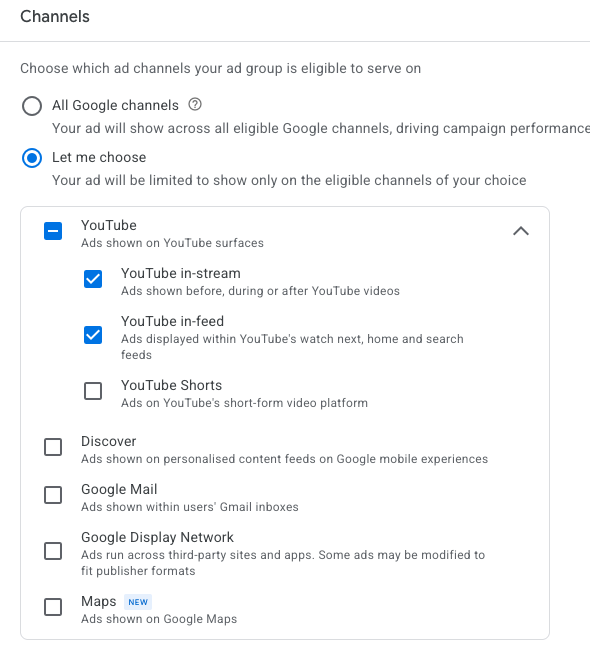
This matters more than it sounds. If you leave all placements enabled the algorithm will spend heavily on Gmail and Discover where clicks are cheap but conversions are essentially zero for B2B. In our retargeting campaign, Gmail generated 19,449 clicks and zero conversions. YouTube generated 997 clicks and 6 conversions. The lesson: restrict to YouTube before the campaign runs, not after you have wasted budget finding out.
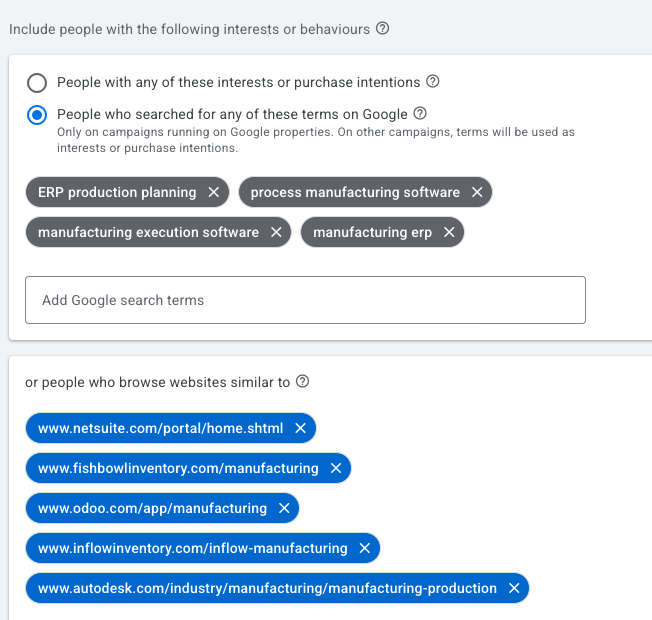
For targeting we used Custom Segments built from two inputs.
Search terms your audience uses when actively researching your category, and competitor or alternative solution URLs your prospects have likely visited. For this client that meant terms like “ERP production planning,” “process manufacturing software” and “manufacturing execution software,” combined with URLs from NetSuite, Odoo, Fishbowl, inFlow and Autodesk.
The video was case study content with real client testimonials. Not a brand video, not an explainer that opens with five seconds of logo animation. People who are researching a category want proof, not positioning.
One placement finding worth noting from the cold audience campaign. In-Stream converted significantly better than In-Feed: 4 conversions at $826 cost per conversion versus In-Feed’s 1 conversion at $3,137.
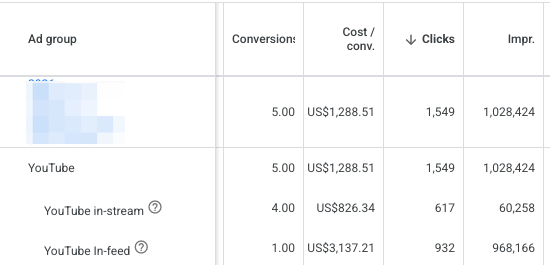
Our hypothesis is that In-Stream reaches people who are actively watching a video and more focused on the content, which gives the algorithm a stronger intent signal to work with. In-Feed appears in the YouTube feed alongside organic content where cold audiences are browsing passively and less likely to take action even if they click.
Demand Gen retargeting
The placement breakdown for retargeting told a different story than cold audience. In-Feed converted significantly better than In-Stream: both delivered 3 conversions each, but In-Feed spent only $911 versus In-Stream’s $3,024. Cost per conversion was $303 for In-Feed versus $1,007 for In-Stream.
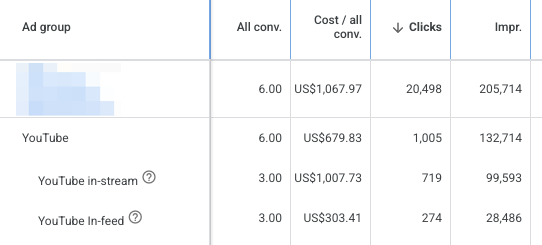
For a warm audience that already knows your brand, In-Feed works because they actively choose to click rather than being forced to watch. The intent is already there so you don’t need the forced view format to build awareness first.
Here is what the data shows across the three campaign types, January to May 2026, YouTube placements only:
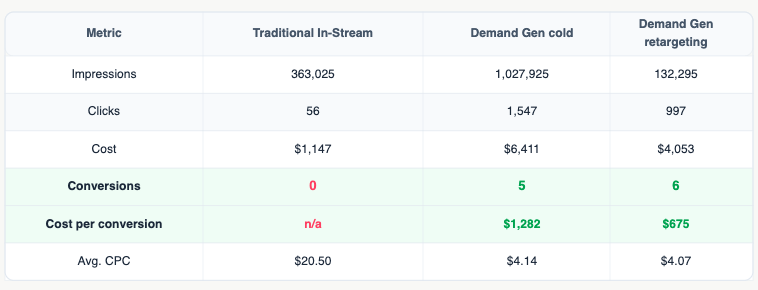
Demand Gen CPC looks higher than In-Stream at first glance. But In-Stream generated zero pipeline at $20.50 per click from people who left in three seconds. Demand Gen generated 11 conversions. Cost per view is a vanity metric for B2B. Cost per pipeline opportunity is what matters.
Disclaimer: The client’s ACV is around $200k, so they are actually very happy with the cost per demo achieved.
The Caveat: What the Data Doesn’t Tell You Yet
These results are promising but incomplete, and I want to be honest about that.
The client has a sales cycle of between 6 and 18 months. Which means we cannot yet calculate true CAC or ROI. A conversion at $675 or $1,282 means a demo request, not a closed deal. We will need another 6 to 12 months of data before we can say with confidence whether this channel delivers positive ROI at the revenue level.
What we can say is that the client’s estimated cost per SQL on other channels is around $1,800. Demand Gen retargeting is producing conversions at $675 and cold audience at $1,282, both below the client’s estimated cost per SQL of $1,200 on other channels.
Encouraging, but not the same as proven ROI. I wouldn’t say YouTube Demand Gen is a reliable revenue channel after one test period of four months but I will keep you updated once we have enough time to get the real results.
Before You Test This
Before you test any of this, the first question to ask yourself is whether you have video content that is actually good enough.
Not AI generated or a cheap brand explainer with stock footage and a logo animation.
Real case study content, real product video, something you would be comfortable showing to a prospect in a sales meeting. If you don’t have that, fix the video before you touch the campaign setup. No bidding strategy or targeting combination will save a video that loses people in the first three seconds.
If your creative is solid, the rest is just execution. Spin up a Demand Gen campaign, set it to Maximize Conversions, and kill the Gmail and Discover placements before launch. Build your Custom Segments from raw search terms and competitor URLs for cold audiences, high-intent page visitors for retargeting, sync your CRM so you’re feeding Google real pipeline signals not form fills, and let the algorithm run.
If you’re ready for an honest assessment of what is and isn’t working with your account, that’s what we do at Getuplead. Let’s talk.