Because the average attention span of any given Internet user is very low (12 seconds, max), as a digital marketing-using brand, you’ll need to make sure your online content grabs – and keeps – the attention of your target audience.
Platforms, such as LinkedIn, are heavily-saturated with advertising content, which also drums in the importance of your content standing out.
Also, if you’re focusing your content on a targeted audience (which you should be if you want it to be successful!), it is important to make sure your LinkedIn ads are being scheduled at the right time (AKA, your audience’s peak times), to increase the chance of lead generation and conversion. Let’s dig in one of the most important LinkedIn Ads metrics: the LinkedIn ad frequency.
1 – What is LinkedIn Ad Frequency?
Ad frequency on LinkedIn is the total number of times your ad campaign is seen by a unique user. It is calculated by dividing your total number of ad impressions by your total ad reach.
Meaning, if you ran a LinkedIn ad campaign for one week, targeting 4000 people that gained 5000 impressions, your ad frequency will be 1.25. This means that most unique users saw your ad 1 to 2 times.
2 – How to Find Your LinkedIn Ads Frequency
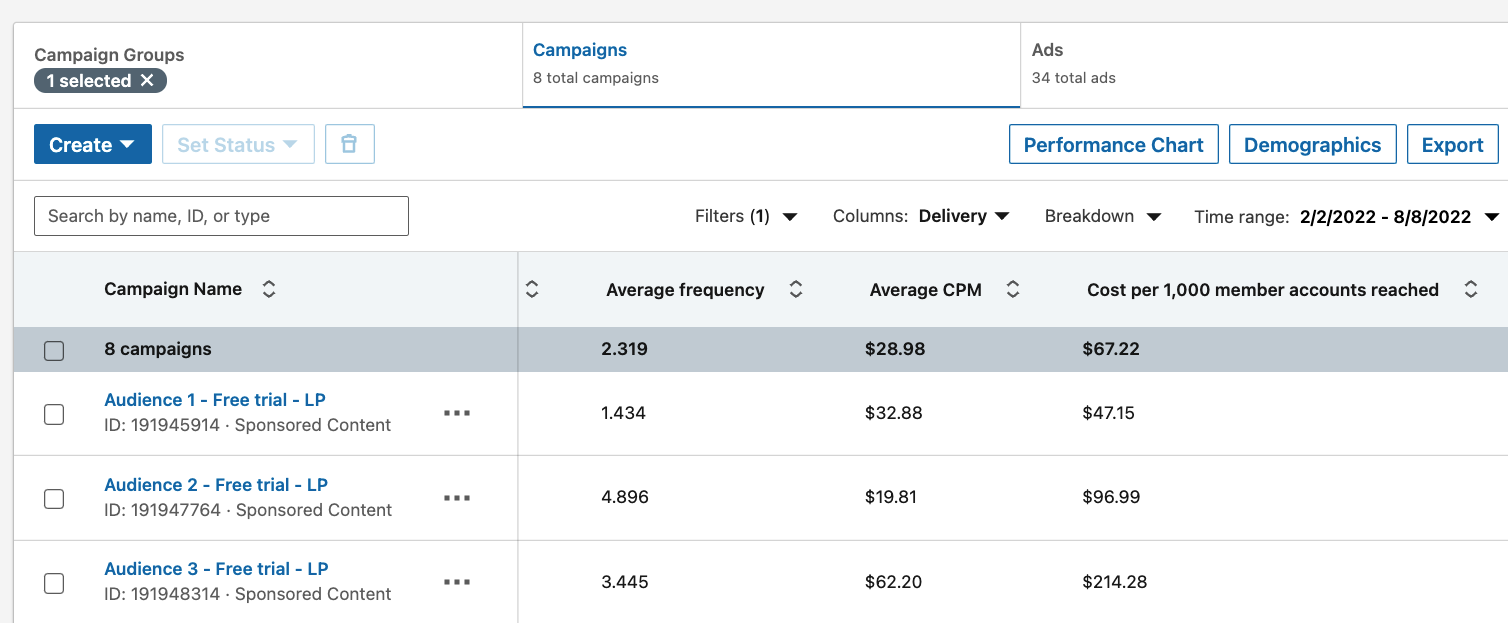
You can view your Ads Frequency on LinkedIn by doing the following:
– Log into Campaign Manager on LinkedIn.
– Select the campaign group, campaign, or ad you want to monitor.
– Change the “Columns” dropdown to “Delivery”.
3 – What LinkedIn Ad Frequency Should I Aim For?
Here’s what most marketers get wrong: they worry too much about ad fatigue and not enough about being seen.
Think about it. You probably go to LinkedIn daily and actively consume content from creators you follow. Can you remember 95% of what you read? Of course not. Now try remembering 3 ads you saw today.
Not easy, right?
Ads show up uninvited and compete against organic content at a disadvantage. You need repetition to break through the noise.
Frequency Targets Over 30 Days:
Cold Campaigns:
- All campaigns combined: 8-12 frequency
- Individual campaigns: 4 frequency minimum
- Absolute minimum if budget-constrained: 6 frequency
Retargeting Campaigns (in-feed):
- All campaigns combined: 15+ frequency
- Individual campaigns: 6 frequency minimum
- Absolute minimum if budget-constrained: 8 frequency
A campaign with frequency below 2 is invisible. You’re wasting money.

Don’t Forget Audience Penetration:
High frequency means nothing if you’re only reaching a small portion of your audience. This often happens with low bids – you reach the cheapest segment, which is usually least likely to buy.
Target penetration rates:
- Cold campaigns: 30-50%
- Retargeting: 70-90%

The Bottom Line:
It’s better to be slightly annoying and oversaturate than to spread your budget so thin that you’re invisible. Your audience won’t remember you after one impression. They probably won’t remember you after three. But by impression 8-12, you might actually register in their consciousness
4 – What Influences Ad Frequency (& How To Increase It Successfully)
It may be tempting to increase the frequency of your ads to ensure they’re being seen, but unfortunately, this can result in what we mentioned earlier – ad fatigue – which will make your audience feel like they’re being targeted by spam.
What Affects Ad Frequency?
There are a few factors that may influence your ad frequency, including:
Ad Types
LinkedIn offers more than one ad type/format, such as basic text ads, video ads, and so on.
Retargeting
If your ad is a retargeting ad, this also influences your ad frequency. Retargeting audiences tend to be smaller than the initial campaign’s audience. And with retargeting ads, if you’ve done a/b testing prior, this should give you some insight on the best ad frequency for this campaign.
Audience & Budget Size
If you want to increase frequency, you can decrease your audience size, so your ad is being shown to a much smaller (but more relevant) audience at a more frequent rate. Conversely, you can increase your daily budget, so that your ad is more beneficial to your audience size, if you want to advertise on a larger scale.
Please note: if you’re a SME or you’re just starting out as a company, it is likely your audience will be on the smaller side. It is worth mentioning here that the minimum number of users in an audience should be 300.
5 – LinkedIn’s Frequency Capping (And Why It Doesn’t Work Yet)
You can also use the LinkedIn Frequency Capping feature which sets the maximum number of impressions within 7 days for each user.

Sounds useful, right?
Here’s the problem: they didn’t fix the issues from the Beta version.
The Two Major Issues:
- The minimum threshold is too high – You can’t set it below 3 impressions per 7 days. That means a frequency of 12+ over 30 days. Nobody wants a frequency of 12 for a single in-feed campaign. Even for retargeting, that’s overkill.
- It’s only available for Awareness objectives – This kills the feature’s usefulness. Awareness is a niche objective for long-term campaigns, but the campaigns that actually need frequency capping (text ads, spotlight, follower ads that easily hit 20+ frequency) perform best with other objectives.
Why These Limitations Exist
LinkedIn has a hard-forced rule: users can get maximum 4 impressions from one campaign over 48 hours. The minimum setting (1 impression over 48 hours) translates to roughly 3 impressions per 6 days, suspiciously close to the 3 per 7 days minimum threshold. This suggests technical limitations rather than strategic choices.
When Frequency Capping Actually Makes Sense
The only real use case with current limitations: short-term announcement campaigns where you need massive reach quickly. But short-term campaigns rarely work in B2B, and you’d want Website Visits objective anyway.
Expert Tip: Frequency Capping remains more of a limitation than a solution. For now, manage frequency the old way: monitor your metrics closely and adjust audience size and budget accordingly.
Conclusion
The content you create plays an important role in your LinkedIn ad campaigns’ success, but so do other factors, such as ad type, warmth of audience, and the frequency of when your ads are being displayed.
There is no ideal number of times an ad should be displayed on a day-to-day basis over the span of your campaign being live, but with a little a/b testing and paying attention to certain factors as mentioned above, you should be able to find your campaign’s own “sweet spot”.
If you’d like to learn more about how we help B2B SaaS and Tech companies grow their MRR through LinkedIn advertising, contact us online or send us an email today at info@getuplead.com to speak with someone on our team.
You might also be interested: